4F, Samjeong Tower, 672 Jungang-daero, Busanjin-gu, Busan, Korea
Forehead · Seomyeon, Busan · Foreigner-Friendly
Forehead lines in Busan Seomyeon, and why brows are part of the calculation.
The muscle that creates forehead lines is the same one holding your eyebrows up. Relaxing it without accounting for that trade is the most common reason patients report looking tired after botox.
Brow position is assessed before any forehead dosing
On This Page
Why does the forehead lift the brows?
Who is most at risk of heaviness?
How is it dosed to avoid it?
Why do the frown lines get worse?
Why is this the treatment most often done badly?
How does this fit alongside other treatment?
What produces asymmetry?
What if my forehead lines are static?
Can heaviness be corrected?
What about the brow lift effect people describe?
How should a first forehead treatment be approached?
Forehead botox is the treatment most often done badly, and the failure is rarely technical. It comes from treating the lines as the whole problem when the muscle producing them is also doing structural work.
Does This Sound Familiar?
What patients say about the forehead
I had botox and now my eyebrows feel heavy.
The lines are gone but I look tired.
One brow sits lower than the other now.
My forehead is smooth but the lines between my brows got worse.
I want the lines softer without losing my expression.
All five describe the same underlying trade being handled badly. The sections below explain what is happening.
Why does the forehead lift the brows?
Because the frontalis is the only muscle that raises them. It runs vertically across the forehead and its contraction both lifts the brows and creases the skin above — the lines and the lift are produced by the same action. Relaxing the muscle removes the lines and, unavoidably, some of the lift. That is not a complication; it is the mechanism, and a plan that ignores it produces heavy brows.
Who is most at risk of heaviness?
Patients whose brows are already sitting low, and patients who unconsciously use the frontalis to compensate for hooded upper lids. The second group is the one that suffers most — they have been holding their brows up all day without realising, and removing that support makes the hooding immediately obvious. Assessing brow position and lid hooding before dosing is the step that prevents this.
How is it dosed to avoid it?
Conservatively, higher on the forehead, and with the lower third treated lightly or not at all. Units are placed above the point where the muscle does most of its lifting work, which softens the upper lines while preserving support. The result is fewer lines rather than no lines — see wrinkle botox. Patients wanting a completely smooth forehead are the ones most likely to be disappointed by what comes with it.
Why do the frown lines get worse?
Because the glabellar complex pulls the brows down and the frontalis pulls them up, and they must be treated as a pair. Treating the forehead alone leaves the depressors unopposed, which drags the brows lower and deepens the frown. Treating the glabella alone can produce a raised, surprised look. Balanced dosing across both is not an upsell — it is what makes either treatment work properly.
Why is this the treatment most often done badly?
Because it is the cheapest and quickest thing on most menus, which means it is frequently sold without the assessment it needs. Dosing the forehead properly requires looking at brow height, lid hooding, how hard the frontalis is working at rest, and whether the patient has been unconsciously compensating for years — none of which takes long, and all of which get skipped when the treatment is treated as a commodity. The technical injection is genuinely simple; the judgement about how much and where is not.
Conservative first, add later — the sequence that avoids heaviness
How does this fit alongside other treatment?
It sits early in most plans because it is low cost and reversible, and because it changes how the upper face reads before anything structural is considered. Where hooding or brow descent is the actual concern rather than lines, energy lifting
across the brow and temple does more than botox
can. Where the skin itself is etched rather than folding, boosters
or resurfacing
belong in the plan alongside. Treating lines in isolation when the underlying issue is descent is the same category of error as filling a fold instead of restoring the cheek above it.
What produces asymmetry?
Usually pre-existing asymmetry becoming visible rather than uneven injection. Most faces have one brow slightly higher, and the frontalis compensates asymmetrically without anyone noticing. Relaxing it removes the compensation and reveals the underlying difference. This is correctable with a few units at the two-week review, which is precisely what that appointment exists for.
What if my forehead lines are static?
Then botox alone will not remove them, and being told that beforehand saves disappointment. A line etched into the dermis over decades needs the skin resurfaced or the crease supported, not just the muscle relaxed. Boosters
improve dermal quality across the area, and resurfacing
addresses the etched line directly. Botox stops it deepening further, which is a genuine benefit and a different claim.
Can heaviness be corrected?
Partially and with patience. A few units into the brow depressors can lift the tail of the brow somewhat, which helps. Otherwise it resolves as the toxin wears off over three to four months. There is no way to reverse botulinum toxin, which is why conservative first dosing matters more here than almost anywhere — adding units at two weeks is easy, subtracting them is impossible.
What about the brow lift effect people describe?
It is real and it comes from treating the depressors rather than the frontalis. Relaxing the glabellar complex and the lateral orbicularis allows the frontalis to lift unopposed, raising the brow tail by a few millimetres. That is a different treatment from forehead line softening and it is worth asking for specifically if brow position rather than lines is what bothers you.
How should a first forehead treatment be approached?
Under-dose deliberately and review at two weeks. That appointment is where units are added if movement is more than you wanted, asymmetry corrected, and the brow position assessed once everything has settled. Patients treated to the maximum on a first visit have no route back for three months. Nothing about this is unique to us — it is how the treatment should be done anywhere, and worth asking about.
Our Medical Team
Who will actually treat you at JRYN Seomyeon?
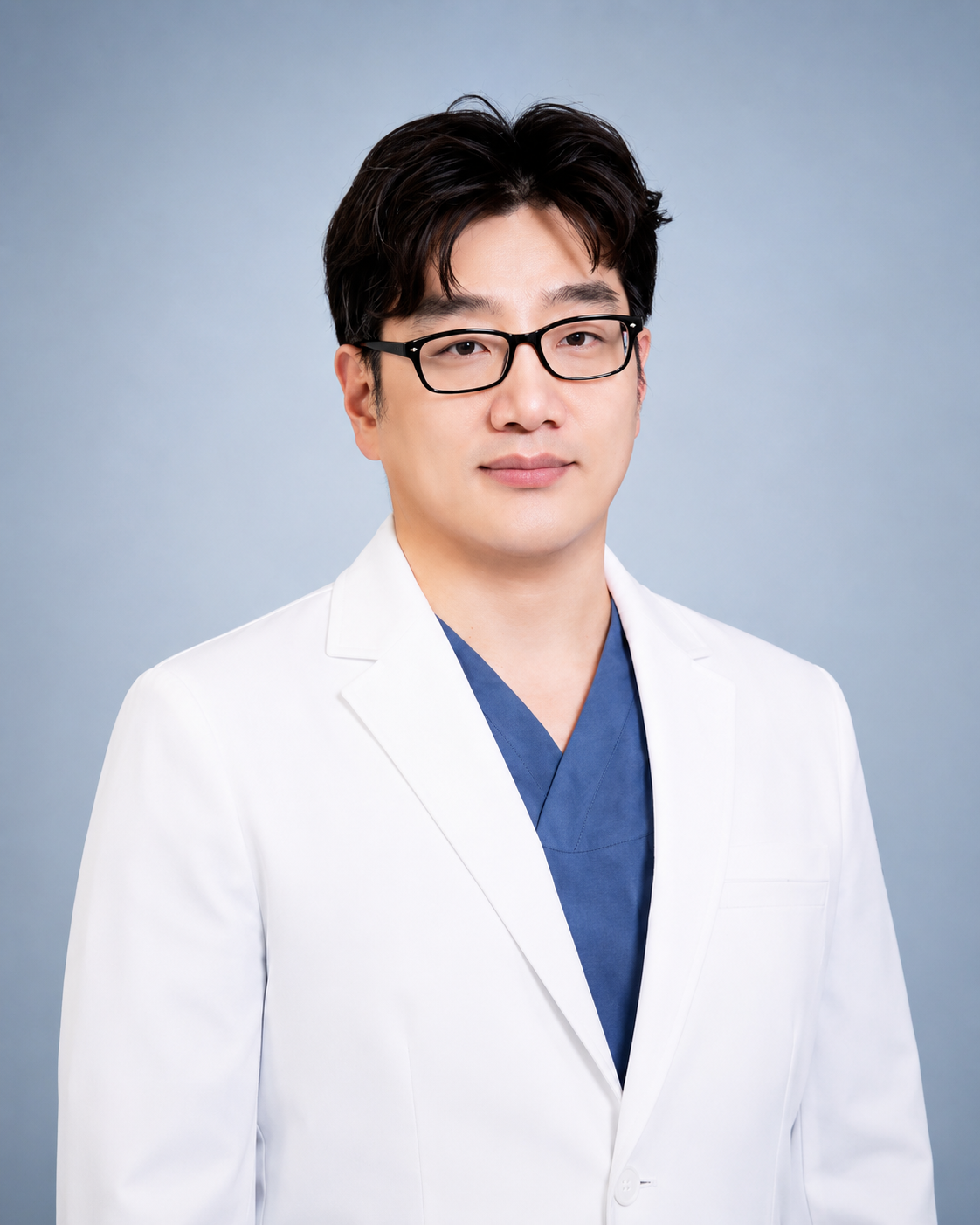
A doctor, in person, every time — never a nurse or a coordinator. JRYN Seomyeon has three doctors, and the clinic was founded by Dr. Jeong Heon Lee, who still consults here. What you actually need is decided during the consultation after your skin is examined, not from a fixed package chosen in advance.
Three doctors, one standard of care.
Every treatment plan at JRYN Seomyeon is decided and performed in person by one of our doctors — led by Dr. Jeong Heon Lee, founder of JRYN Dermatology.
From the Founder
The consultation is the treatment.
Most patients arrive asking for a specific treatment. My job is to check whether it is the right one for what they actually have. Getting that wrong is the most common mistake I correct.
Graduated from Inje University
Current Head of the JRYN Network
Current Chief Director of JRYN Seomyeon
Former Chief Director of Lin Clinic
Former Chief Director of Centum Lin Clinic
Managing Director · Seomyeon Main Branch
Dr. Yoon Jung-wook
Full Member, Korean Society of Aesthetic Plastic Surgery
Full Member, Korean Society for Aesthetic Plastic Surgery & Laser Medicine
Full Member, Korean Society of Obesity & Body Contouring
Former Neurosurgery Resident (3rd Year), Dong-A University Hospital
Former Intern, Dong-A University Hospital
Former Chief Director, Forever Plastic Surgery & Dermatology (Changwon)
Former Chief Director, Lovely Plastic Surgery & Dermatology (Changwon)
Former Director, Insta Plastic Surgery & Dermatology (Gimhae)
Former Director, Dr. Yoon Beauty Center (Vietnam)
Vice Managing Director · Seomyeon Main Branch
Dr. Jin Tae-wan
Former Director of Dermatology, MediWoman Women's Clinic
Former Director of Dermatology, Hangdo Quantum Clinic
Former Chief Director, AGE Clinic (formerly Paresa Clinic)
Former Chief Director, One Clinic (Guro)
Former Director, One Clinic (Gangnam)
Former Chief Director, SKY Plastic Surgery (Jongno)
Former Visiting Physician, Guangfu Aesthetic Plastic Surgery Hospital (Dalian, China)
Former Associate Director, Tokeshi Plastic Surgery
Former Associate Director, Midam Dermatology Clinic
Former Associate Director, Noble Line Plastic Surgery
Former Associate Director, Jeniva Plastic Surgery
Former Military Flight Surgeon, ROK Army Aviation Operations Command
Former Intern & Resident, Kangdong Sacred Heart Hospital
Before You Book
Questions patients ask first.
Typically eight to sixteen for the forehead alone, more for men given higher muscle bulk. It is always dosed alongside the glabella rather than in isolation — see wrinkle botox.
Only if over-dosed. Conservative placement leaves visible movement with softened lines, which is what most patients actually want when asked directly.
Three to five days for onset, full effect at two weeks. Judging the result at day four is why patients sometimes conclude it did not work.
Yes, with careful dosing and often with the forehead treated lightly. Significant hooding is anatomy rather than muscle, and where it dominates the appearance the honest answer may be surgical.
It slows the process, since skin that is not repeatedly folded creases more slowly. That is the strongest argument for treating dynamic lines in the early thirties — see what matters at 25, 35 and 45.
No — it lasts as long as the toxin, three to four months. Structural brow position needs lifting
or surgery depending on degree.
Tell us rather than waiting it out. Depressor units can partially offset heaviness, asymmetry corrects in minutes, and everything resolves within three to four months regardless.
Some patients with tension headaches report improvement, and there is a licensed indication for chronic migraine at different doses and injection patterns. That is a separate treatment from cosmetic forehead botox.
Doctor-led planning across six categories. Foreign patients pay the same as local patients — what changes a final figure is units and area, never nationality.
JRYN Seomyeon
· 4F Samjeong Tower, 672 Jungang-daero · 5 min from Seomyeon Station Exit 2 · 2 min from Seomyeon Mall Exit 16 · 6 min from Lotte Department Store Busan Main · 8 min from Jeonpo Cafe Street · inside Seomyeon Medical Street · open through lunch, seven days a week
Ready When You Are
Send your dates, get a plan before you fly.
Message us on WhatsApp with what you would like to address and when you will be in Busan. You will get an honest read in your language — including whether the treatment you have in mind is the right one.